If ChatGPT can complete an assignment for a student in two seconds, it’s natural for the student to feel tempted to use it. Who remembers the paragraph on “responsible AI usage” in the syllabus when an assignment is due in an hour? No wonder this is educators’ most common concern regarding AI.
When creating or revising assignments, educators should first rethink the learning objectives. According to Dr. Janet Rankin, director of the MIT Teaching and Learning Lab, educators should focus on what they want their students to achieve (Feijo & Ouellette, 2023). AI benefits students only when the students already have three foundations: a strong foundation of knowledge to understand AI’s output, an intellectual capacity to think critically about the AI’s output, and the integrity to act responsibly with the information they receive.
Assignments can be of at least two types. In some assignments, the goal is for students to learn for themselves a skill that AI can easily perform. For these assignments, educators should emphasize the importance of independent work and align evaluation rubrics with this goal. Educators could say, “You should be able to do this unassisted.” For example, in creative writing assignments, independent writing can be a key skill for students to develop. Similarly, in computer programming courses, learning the basics of coding is essential (something AI can easily do). In such cases, AI tools should be restricted so the students can develop the intended skills.
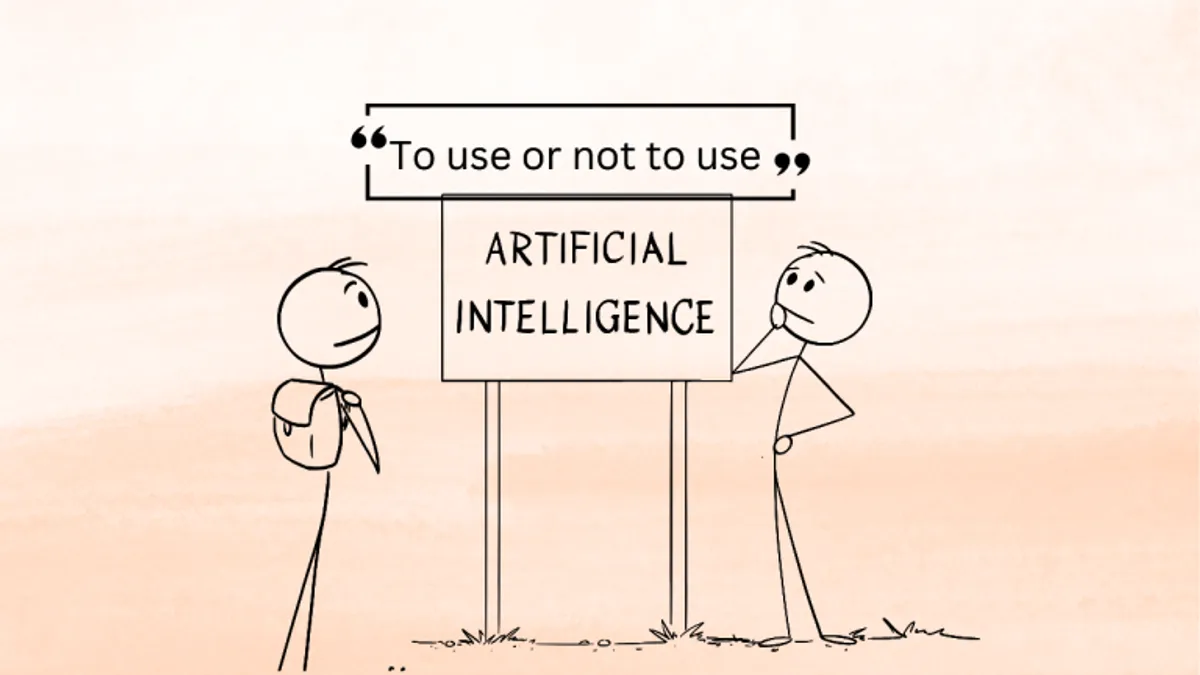
Whether to ban or allow AI is not really the question. “AI” is an umbrella term for many different tools, from chatbots that can write a whole essay to grammar checkers and tools that explain an error message. A more useful approach is to look at specific AI tools and decide which ones fit which grade levels, and at what point students should start using them. Researchers are working on this kind of mapping. In the meantime, Process Feedback, a free online platform developed by Dr. Badri Adhikari at the University of Missouri–St. Louis, is a resource that can help educators and students put AI in its place.
One way to do this is to ask students to reflect on their AI use after an assignment. In the AI use reflection activity, students list each time they used an AI tool and rate how much it helped the final product and how much it helped their own learning. Comparing the two ratings can help students see which uses of AI supported their learning and which only produced text.
On the other hand, if the goal of an assignment is for students to learn higher-order skills, the assignment and rubric may need to be revised. For example, an assignment that only asks students to summarize a book chapter could be revised to require them to apply the knowledge to a real-world problem.
Educators should assess if their learning objectives will be better fulfilled with or without AI usage. What should students be able to do with ChatGPT and without it? If students learn more by using AI, then the rubrics should be revised to capture these objectives.