Why use Process Feedback
Process Feedback’s main purpose is to offer students and teachers data to discuss or reflect on the writing process so the process can be improved.
It helps students become meta thinkers

Process Feedback is not primarily about promoting academic integrity (AI) or encouraging/discouraging the use of artificial intelligence (AI). As explained in the peer-reviewed research paper published in Education Sciences, the primary purpose is to offer students and teachers data to reflect on the writing process. Thinking improves not just through doing, but through reflecting on the doing.
We do not learn from experience, we learn from reflecting on experience.
John Dewey
American Educational Reformer
Benefits to students
Learning about how you write can improve you
Since the 1970s, education research has shown that being aware of your process improves critical thinking, metacognition, and self-awareness. Thinking about how you learn helps you plan, monitor, and grow.
Data-driven guided reflection can be powerful
Students rarely get a chance to collect data about their working process. Process Feedback helps students notice when they are most productive, when they take breaks, and how they manage their time across a project.
Feedback on the working process is invaluable
Students don’t often receive process feedback. By reflecting on and sharing their process, students can show their effort, improve their time management, and receive feedback that leads to better results.
Safe AI integration
AI can be a powerful learning tool when used safely
Guardrails are essential for bringing AI into education. Most AI tools aren’t fit for educational purposes when used directly/openly. In Process Feedback, AI is integrated in a way that protects student learning.
Process Feedback makes AI support safer for students
Our writing and coding platforms use AI carefully. Students can get explanations and feedback related to their writing or code, not generate solutions directly.
Research shows it especially helps novice and female students
A recent research published in IEEE Frontiers in Education, shows that guided AI support can make a big difference for students who are newer to a subject or traditionally underrepresented.

Benefits for teachers and institutions
No accounts, logins, or sign ups needed
Students can start using Process Feedback editors right away without creating accounts or giving up their privacy.
Built to respect student privacy
Process Feedback editors or applications do not automatically collect any student behavior data while they are working on their tasks.
Get meaningful insights into struggling students
With writing process reports (or student reflections) shared by students, teachers can receive both detailed and high-level data on students who may be struggling in their course.
Reflect on your own teaching too
Seeing how students work can give teachers new insights into their own teaching methods and help them grow more effective.
It’s the opposite of cheating
In this episode of the “Opposite of Cheating Podcast”, Anna Mills discusses how tools like Process Feedback can be the opposite of cheating.
The surprising power of reflection
Preexisting beliefs can block real learning
One big reason students struggle to learn is because they hold on to old beliefs. Reflection creates space for students to question and rethink what they know.
Seeing the process leads to new insights
When students explore their process data, they can see how they actually work, not just how they think they work. This opens the door to new habits and better learning strategies.
Reflection improves real-world skills
A reflection exercise gives students a chance to examine, discuss, analyze, and adjust how they approach their work.
The ability to reflect on what is being written seems to be the essence of the difference between able and not-so-able writers from their initial writing experience onward.
Kathleen Blake Yancey
Reflection in the Writing Classroom
Training students to be reflexive practitioners
Reflexivity means reflection becomes part of who they are
The goal is for students to not just complete a reflection exercise, but to be changed by it. Reflexive students naturally adjust, question, and improve their work in real time. Reflection is a journey towards journey towards reflexivity .
Reflection is important, but reflexivity goes even further
It is not enough for students to reflect after the fact. We want them to grow into reflexive practitioners who think critically during and after their work.
Two types of reflection matter and students need both:
Reflection-on-action: thinking back after the work is done
Reflection-in-action: thinking critically while they are actively working
Process Feedback supports both types of reflection
Our tools encourage reflection-in-action and reflection-on-action, helping students move from simple reflection to deep reflexivity.
What happens without Process Feedback
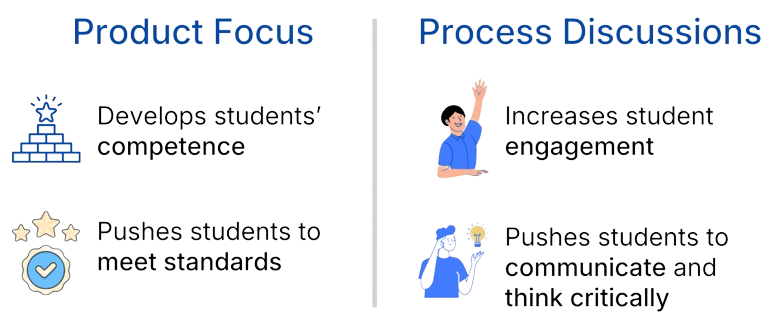
Product matters, but process matters too
Focusing only on the final product helps students meet standards, but it leaves out deeper skills like engagement, communication, and critical thinking.
Without process reflection, students miss key growth opportunities
If we never ask students to reflect on how they work, how can we expect them to truly think for themselves?
Process Feedback bridges the gap
It makes it easy to capture and discuss the writing or coding process, whether students work independently or use AI support.
Easy to integrate with your existing tools
Process Feedback works smoothly alongside popular learning platforms and requires no complicated setup.